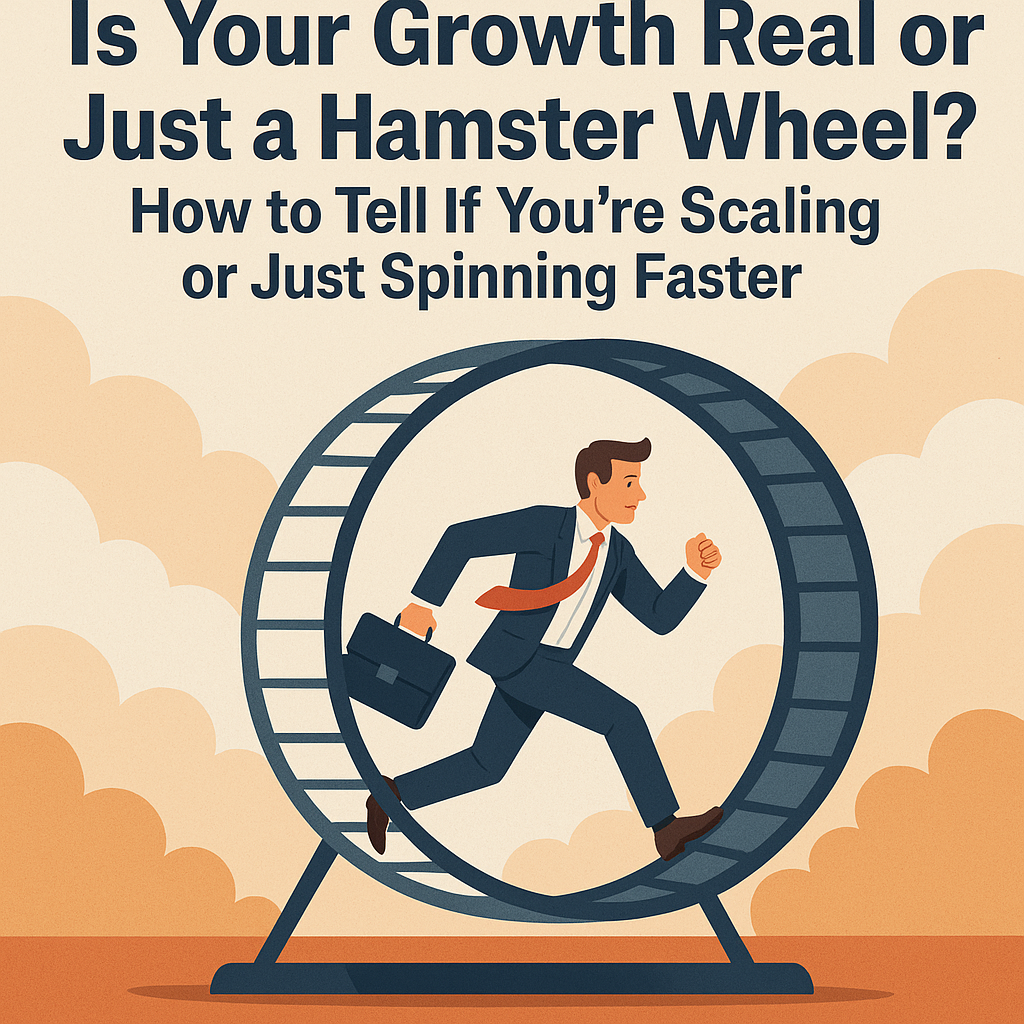
Every entrepreneur dreams of scaling. We envision exponential growth, expanding impact, and a business that hums with efficiency as it reaches new heights. But let’s be honest, for many founders and business operators leading $1M-$10M businesses, the reality often feels less like scaling and more like a relentless sprint on a hamster wheel. You’re working harder than ever, revenue might be climbing, but are you truly building a more valuable, sustainable, and scalable enterprise, or are you just spinning faster to stay in place?
This is a question that gnaws at the most ambitious among us. You’re past the initial scramble, you’ve achieved significant traction, but now you’re feeling the strain. Customer demands are up, your team is stretched thin, and you’re personally wearing more hats than ever. It’s a critical inflection point where the wrong path can lead to burnout, stalled growth, or even a downward spiral. The good news is, there’s a clear distinction, and once you recognize it, you can recalibrate your efforts for genuine, sustainable scale.
The Core Insight: Scalability is About Leverage, Not Just Volume
Here’s the fundamental truth that separates true scaling from mere busywork: Scaling is the ability to increase revenue and impact disproportionately to the increase in resources (time, money, people). It’s about building leverage. Spinning faster, on the other hand, is when your revenue growth is directly, or even less than directly, proportional to your increased input. You’re just adding more effort to get more output, without truly optimizing the underlying systems.
Think of it this way:
- Spinning Faster: You hire another salesperson, and your sales go up. You work an extra 10 hours a week, and you close more deals. You add more customer service reps as your customer base grows, just to maintain the same service level.
- Scaling: You implement a CRM system that automates follow-ups, allowing your existing sales team to close more deals with the same effort. You refine your onboarding process, reducing churn without adding more support staff. You develop a repeatable marketing funnel that generates leads passively, requiring less manual input per lead.
The goal isn’t just to get bigger; it’s to get more efficient as you get bigger.
Red Flags: Are You Just Getting Busier, Not Better?
How do you diagnose if you’re on the hamster wheel? Look for these tell-tale signs within your operations:
Your Team is Drowning, Not Growing
- Constant Firefighting: Are your team members, and especially you, spending more time reacting to problems than proactively building or improving?
- Capacity Overload: Is everyone perpetually at 110% capacity, with no bandwidth for strategic work or development?
- High Turnover or Burnout: Are key team members leaving due to stress, or are you noticing a general dip in morale? This isn’t growth; it’s attrition waiting to happen.
Your Processes Are Manual, Not Automated
- Repetitive Tasks: Are your team (or you!) performing the same manual tasks repeatedly? Think data entry, report generation, or basic customer inquiries.
- Lack of Systems: Are your operations reliant on heroic individual effort rather than clearly defined, repeatable systems and tools?
- Information Silos: Is vital business information scattered across spreadsheets, emails, and individual brains, rather than centralized and accessible?
Your Costs Are Growing as Fast as (or Faster Than) Your Revenue
- Declining Margins: Are your profit margins shrinking even as your top-line revenue increases? This indicates that the cost of delivering your service or product is rising disproportionately.
- Uncontrolled Overhead: Are you adding headcount, software subscriptions, or office space without a clear return on investment or leverage point?
- Revenue at Any Cost Mentality: Are you taking on any project or customer, regardless of its profitability or strategic fit, just to hit revenue targets? This can lead to unprofitable growth.
The Pillars of True Scale: Building a Leverage-Driven Business
If you recognize some of these red flags, don’t despair. It’s a common challenge for growth-stage businesses. The key is to shift your focus from simply increasing effort to strategically building leverage.
1. Systemize & Automate Everything Possible
This is the bedrock of scale. Identify every repeatable process in your business and document it. Then, explore how technology can automate or streamline significant portions.
- Workflow Mapping: Visually map out your core processes (sales, marketing, operations, customer service). Where are the bottlenecks? Where are manual hand-offs happening?
- Software & Tools: Invest in CRM, project management, marketing automation, accounting software, and other tools that reduce manual effort and improve data flow.
- Standard Operating Procedures (SOPs): Create clear, concise SOPs for every key task. This empowers your team, reduces errors, and makes onboarding new hires far more efficient.
2. Empower & Develop Your Team (Delegation, Not Dumping)
Scaling requires a team that can operate effectively without your constant direct intervention. This isn’t about offloading; it’s about empowering.
- Clear Roles & Responsibilities: Define what each team member is responsible for, their decision-making authority, and their key performance indicators (KPIs).
- Training & Development: Invest in your team’s skills. The more capable they are, the less dependent they are on you.
- Trust & Autonomy: Delegate effectively. Give your team the resources and authority to make decisions within their areas of responsibility. Your role shifts from doing to leading, coaching, and removing obstacles.
3. Optimize for Profitability, Not Just Revenue
Not all revenue is created equal. True scale focuses on profitable growth.
- Analyze Customer Profitability: Understand which customer segments or types of projects are most profitable and focus your efforts there. Don’t be afraid to say “no” to low-margin or high-effort work.
- Cost Control & Efficiency: Regularly review your expenses. Are there areas where you can reduce costs without sacrificing quality or output? Can you negotiate better terms with suppliers?
- Pricing Strategy: Are you pricing your products or services effectively to capture the value you provide and ensure healthy margins as you grow?
4. Build Repeatable and Predictable Funnels
Manual, ad-hoc sales and marketing efforts don’t scale. You need systems that consistently generate leads and convert them.
- Automated Marketing Funnels: Develop evergreen content, email sequences, and ad campaigns that attract and nurture leads without constant manual input.
- Standardized Sales Process: Define clear stages in your sales process, from lead qualification to closing. Use your CRM to track and optimize.
- Customer Journey Mapping: Understand your customer’s entire experience with your business and look for opportunities to streamline, automate, and enhance touchpoints.
Try This Now: Your “Scale or Spin” Check-Up
To immediately assess your current state and identify areas for action, grab a pen and paper (or open a doc) and answer these questions:
- Your Top 3 Bottlenecks: What are the three biggest things currently slowing down your business or requiring your constant personal intervention?
- Most Repetitive Task: What is one task you or your team do daily/weekly that feels highly repetitive and could potentially be automated or systematized?
- Revenue vs. Resource Growth: Over the last 12 months, did your revenue grow significantly faster than your headcount and operational expenses? Why or why not?
- Team Autonomy Score: On a scale of 1-10 (1=totally reliant on me, 10=fully autonomous), how autonomous is your core team? What’s one thing you can delegate or empower them to do more of this week?
- Profit Margin Trend: Are your gross and net profit margins increasing, decreasing, or staying flat as your revenue grows?
The Path Forward: Intentionality Over Activity
The difference between scaling and spinning faster boils down to intentionality. Are you proactively building systems, empowering your team, and optimizing for leverage, or are you just reacting to the demands of growth? For entrepreneurs, founders, and business operators, the path to sustained success isn’t just about working harder; it’s about working smarter, building resilient systems, and truly transforming your business into a scalable engine, not just a busier one.
What’s one system you’re committed to building or improving this quarter to truly scale your business? Share your thoughts and plans in the comments below!